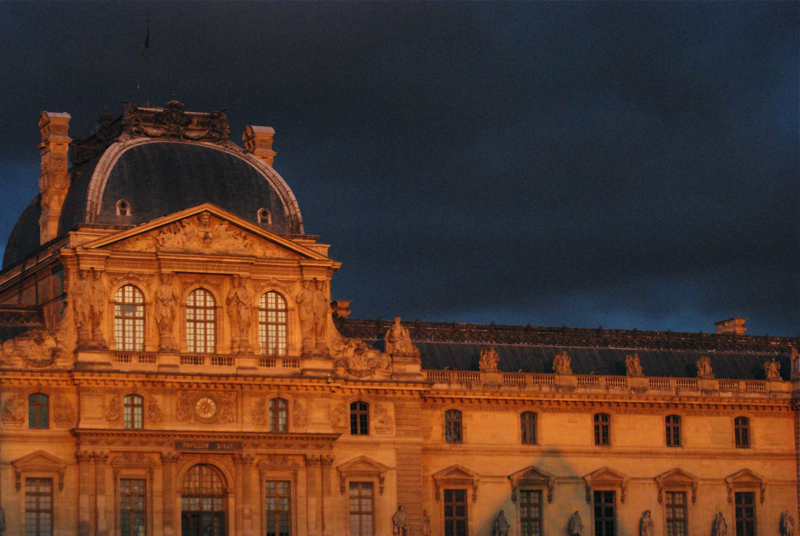
It's hard to believe that we've arrived at the morning of our last full day in Paris! I was so exhausted last night that I didn't have a blog post in me; luckily we're taking it easy this morning and enjoying the light breeze and the view from our flat, so I can put together a post about our yesterday's adventures.
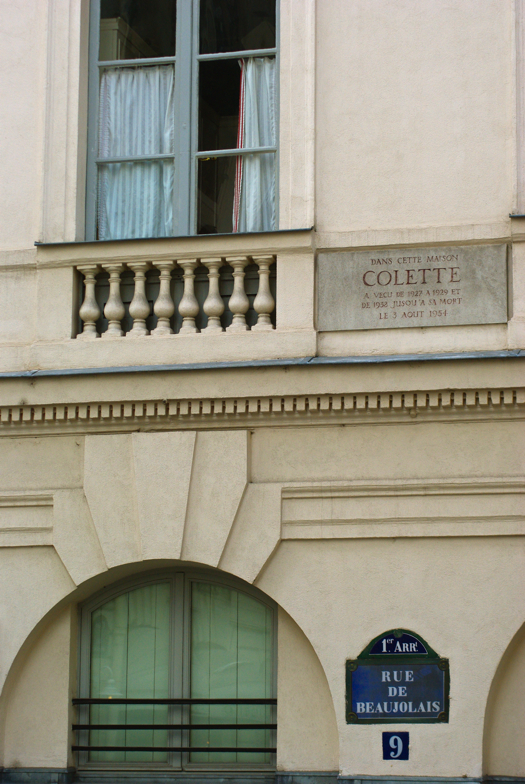
We started out with a little literary tourism in the first arrondissement, locating the site of the apartment at 9 Rue de Beaujolais in which Colette lived from 1938 until her death in 1954. This is the first of these little bookish pilgrimages whose site actually seems to fit—even to evoke—the writer in question; the flats are built over a short gallery with music box and doll shops, and on the back gives onto a public garden, which Colette would, of course, have loved. The streets surrounding the building are narrow and twisting, and discourage any quantity of car traffic. I can easily imagine Colette living out the final decades of her long life here, with her young lovers and her cats.
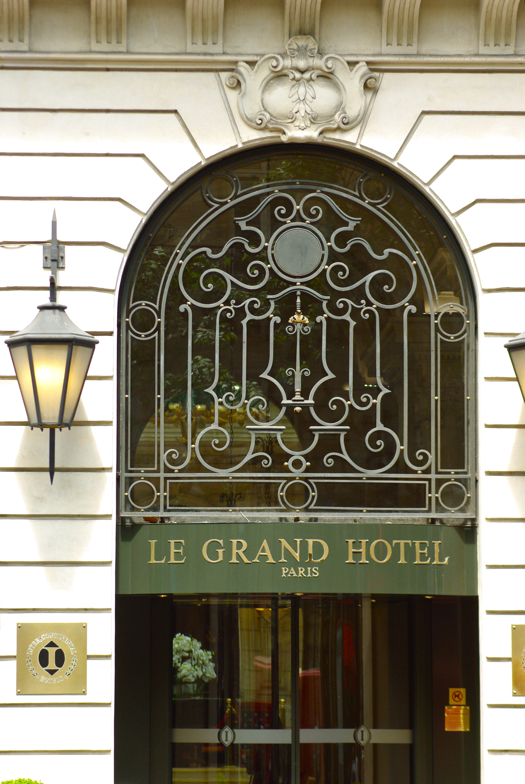
From Colette's flat we strolled over to the wide Boulevard des Capucines and Le Grand Hôtel. These were the deluxe accommodations of the nineteenth century, and I'm sure many luminaries have lodged there (Edith Wharton, perhaps?), but the one we had in mind is Oscar Wilde. This is the hotel in which he was staying when he dashed off Salomé on a whim, after a vigorous luncheon party. Apparently, in one of several anecdotes that convince me I would have found Wilde obnoxious in life even if I'm somewhat charmed by reading about his antics, he dashed down to the street below his window, where a gypsy orchestra was playing. He accosted the band leader, and pronounced "I am writing a play about a woman dancing with her bare feet in the blood of a man she has craved for and slain. I want to you play something in harmony with my thoughts." Oh, Oscar. The hotel building takes up the whole triangular block, and is still very posh; one night there costs about what we spent on a whole week in our Montmartre flat.
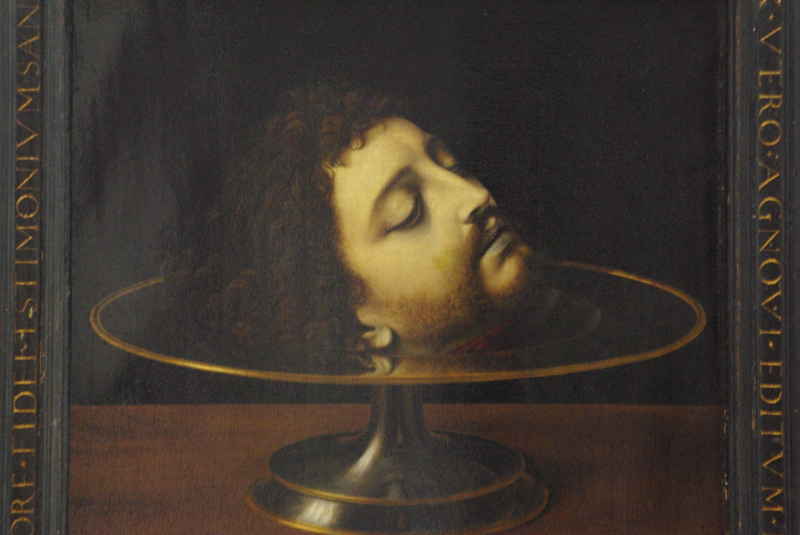
From Wilde's hotel, we turned our steps at last toward the Louvre. I don't think I've ever done so much preparation for a museum visit: my idea, knowing that Proust spent many hours in the Louvre, was to research which of the works referred to in A la recherche du temps perdu are there, and to put together a tour based on those. In addition to being interesting because of my love of the book, this plan had the benefit of providing an "angle" from which to attack the behemoth of a museum, which would have seemed totally overwhelming if I'd approached it cold. It ended up being very rewarding; the only downside was that we spent a bit more time in 18th-century French painting than we might otherwise have done—but even in that case, it was interesting to learn about an era I wouldn't have gravitated to on my own.
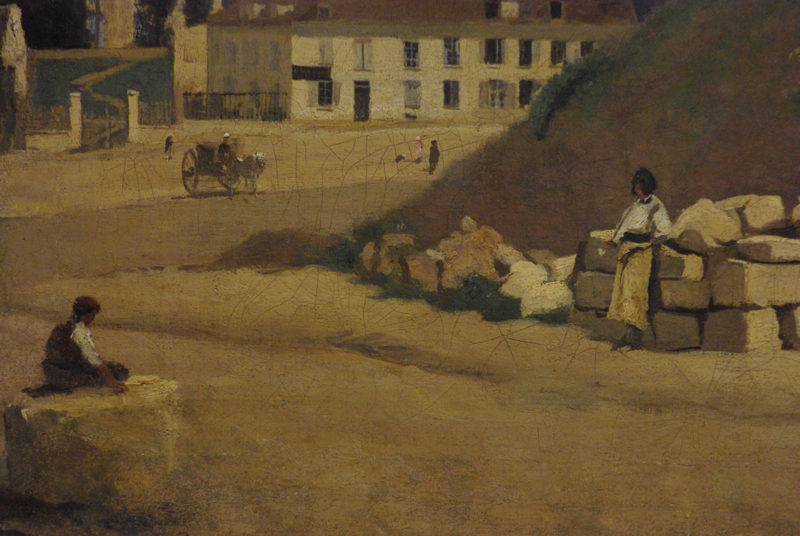
[My grandmother] would have liked me to have in my room photographs of ancient buildings or of beautiful places. But in the moment of buying them, and for all that the subject of the picture had an aesthetic value, she would find that vulgarity and utility had too prominent a part in them, through the mechanical nature of their reproduction by photography. She attempted a subterfuge, if not to eliminate altogether this commercial banality, at least to minimise it, to supplant it to a certain extent with what was art still, to introduce, as it were, several "thicknesses" of art: instead of photographs of Chartres Cathedral, of the Fountains of Saint-Cloud, or of Vesuvius, she would inquire of Swann whether some great painter had not depicted them, and preferred to give me photographs of 'Chartres Cathedral' after Corot, of the 'Fountains of Saint-Cloud' after Hubert Robert, and of 'Vesuvius' after Turner, which were a stage higher in the scale of art.
Putting aside Marcel's grandmother's dismissal of photography as art, I love the idea of "thicknesses of art," articulated here, and it occurred to me that this is more or less what we, and everyone snapping pictures in these museums, are creating. In remixing, re-cropping, shooting from an unexpected angle, or merely recording an image for note-taking purposes, we create another layer, another "thickness." Rooms that are very painting-heavy are generally less exciting to photograph, in my opinion, than collections with a wider variety of media, but this quote inspired me to try. For Marcel's grandmother the painting was merely a means of making Chartres Cathedral present in her grandson's room, but I was drawn to the leisurely-seeming people in the foreground, passing a few minutes on either side of the lane leading to the church in leaning against or sitting on the stone walls.
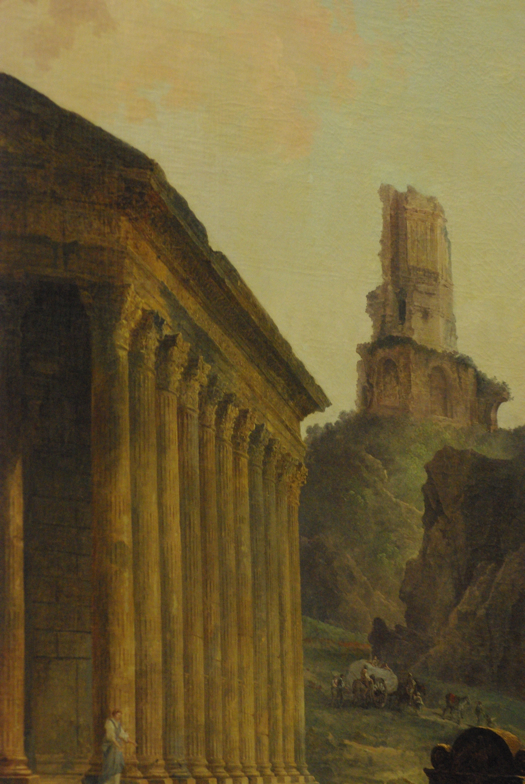
One thing I realized in preparing for this project, is how infrequently Proust's visual art references are to a specific painting rather than a general tendency in a painter's work. He'll say, for example:
[T]he moonlight, copying the art of Hubert Robert, scattered its broken staircases of white marble, its fountains, its iron gates temptingly ajar. Its beams had swept away the telegraph office. All that was left of it was a column, half shattered but preserving the beauty of a ruin which endures for all time.
which could refer to any of Robert's paintings of ruins (and he made a lot of them, the one above being one of my favorites we saw). Or, in another example, he might write that
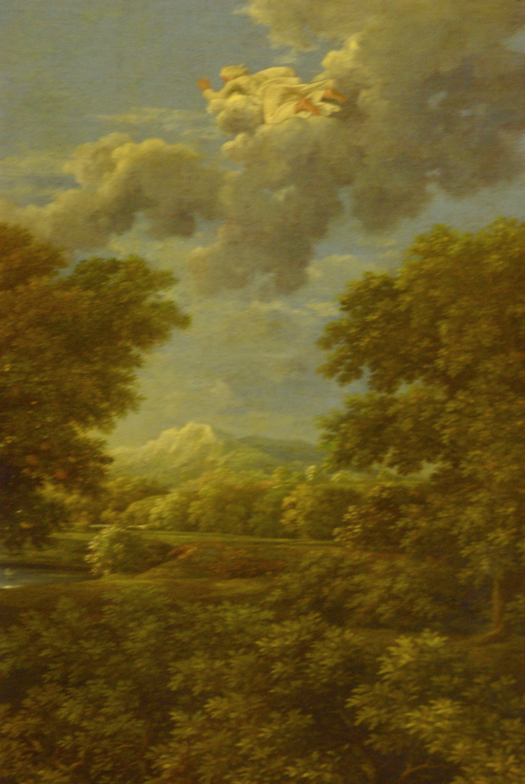
The name Gilberte passed close by me [...] forming, on its celestial passage through the midst of the children and their nursemaids, a little cloud, delicately coloured, resembling one of those clouds that, billowing over a Poussin landscape, reflect minutely, like a cloud in the opera teeming with chariots and horses, some apparition of the life of the gods...
I think the Poussin clouds below are a very nice match here, but I'm sure there are others as well.
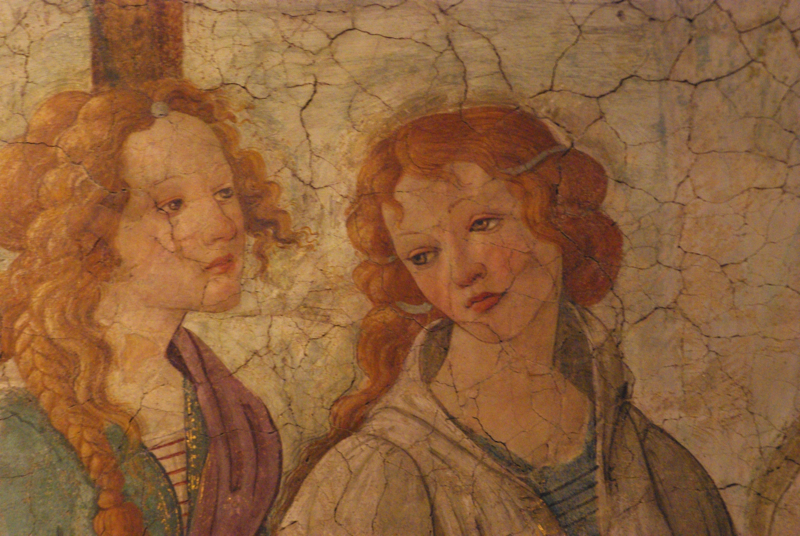
There were likewise many examples of the broken-hearted Botticelli virgins and Venuses to which Swann often likens Odette. The most affecting, in my opinion, were those in a room of frescoes actually relocated from Marcel's beloved Florence.
Of course, the most satisfying instances of an exercise like this is when Proust mentions a specific work which we could then search out. This happened a few times: Rembrandt's Bathsheba, for example, or this Luini fresco of the adoration of the Magi:
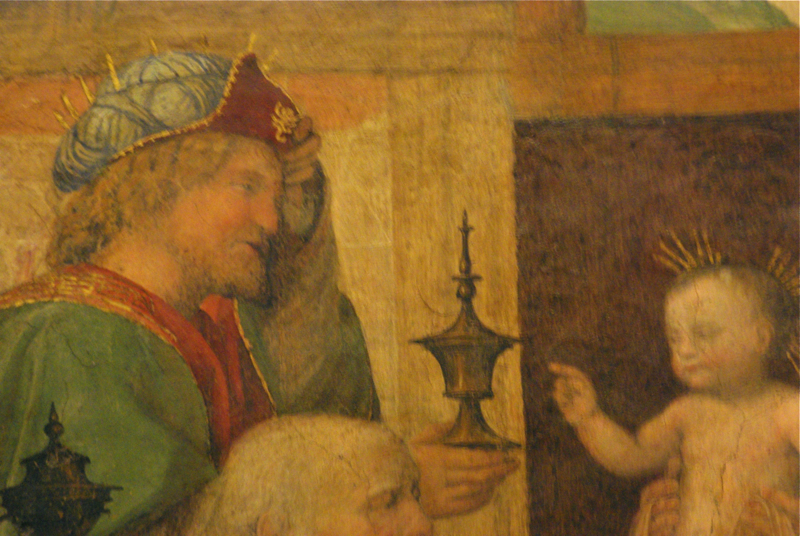
I should have wished [my parents] to understand what an inestimable present I had just received and, to show their gratitude to that generous and courteous Swann who had offered it to me, or to them rather, without seeming any more conscious of its value than the charming Mage with the arched nose and fair hair in Luini's fresco, to whom, it was said, Swann had at one time been thought to bear a striking resemblance.
I was especially excited to find Veronese's Crucifixion painting, as it figures in one of my favorite Proustian passages, both for the beauty of its prose and for the hilariousness of Marcel's ridiculously overwrought psychology. And indeed, the skies depicted do have a certain modern, Parisian, and ominously massing quality about them.
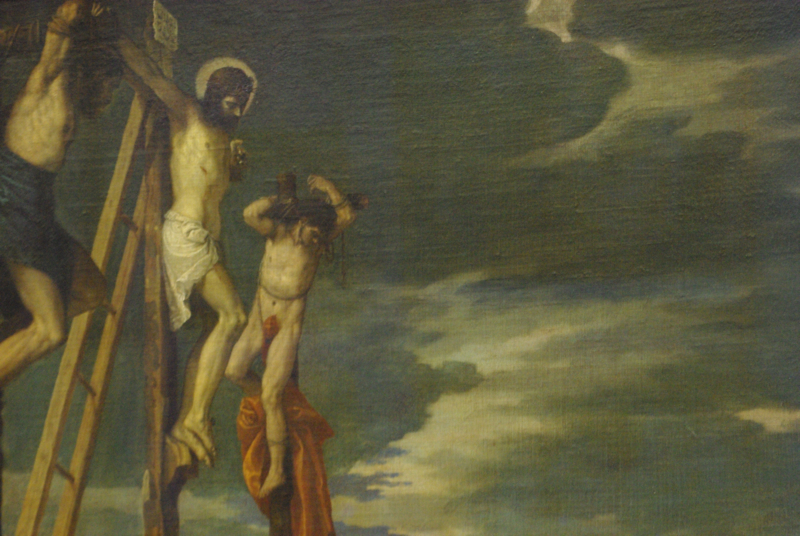
Unhappily those marvellous places, railway stations, from which one sets out for a remote destination, are tragic places also, for if in them the miracle is accomplished whereby scenes which hitherto have had no existence save in our minds are about to become the scenes among which we shall be living, for that very reason we must, as we emerge from the waiting room, abandon any thought of presently finding ourselves once more in the familiar room which but a moment ago still housed us. We must lay aside all hope of going home to sleep in our own bed, once we have decided to penetrate into the pestiferous cavern to which we gain access to the mystery, into one of those vast glass-roofed sheds, like that of Saint-Lazare into which I went to find the train for Balbec, and which extended over the eviscerated city one of those bleak and boundless skies, heavy with an accumulation of dramatic menace, like certain skies painted with an almost Parisian modernity by Mantegna or Veronese, beneath which only some terrible and solemn act could be in progress, such as a departure by train or the erection of the Cross.
This is especially cool since we, too, are about to depart for "Balbec" (actually Cabourg) on the Norman coast; luckily for us, however, we shall not be departing by train.
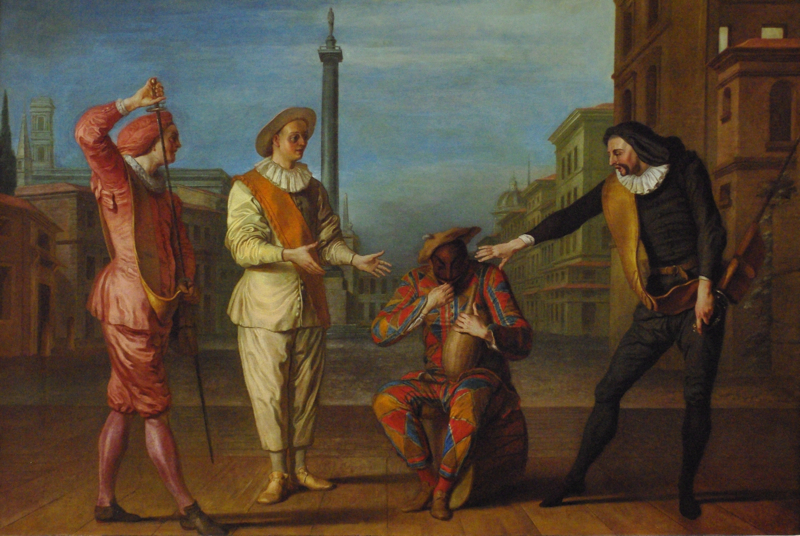
Of course, in looking around for Proustian references we discovered other works that were interesting and appealing. Because my primary interest is modern and contemporary art, I tend to gravitate toward things that remind me of later artists. The backdrop of the above painting, for example, reminds me strongly of De Chirico's flattened, shadowy street scenes, and the Commedia dell'arte figures are reminiscent of his surrealism as well. I tend to love sketches and unfinished pieces as well; this study by Ingres for a later, work struck me as particularly modern.

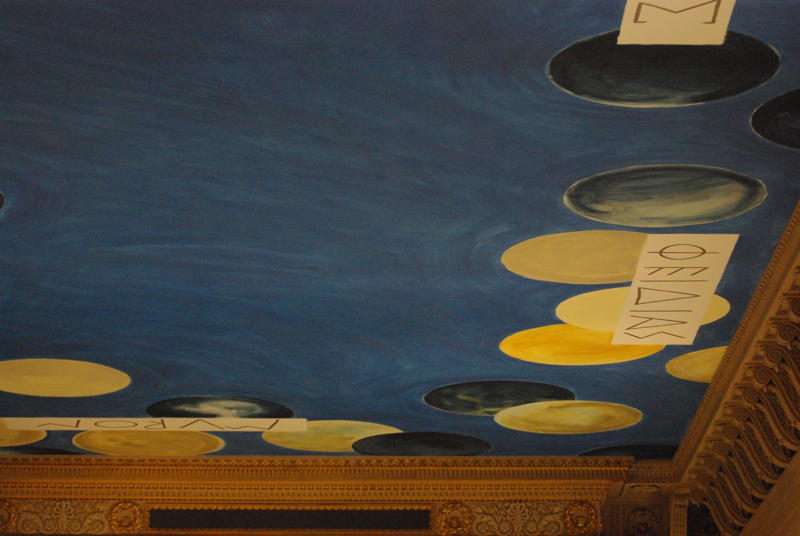
As a lover of modern art, I was also inspired by the extent to which the curators of the Louvre choose to intermingle old and new—not in the actual collections, which stop short of Impressionism, but in the building itself. The most famous example is, of course, I.M. Pei's steel and glass pyramid entrance hall, located in the grand courtyard formed by the three wings of the French Renaissance palace. But there are other examples as well: in a gilt room housing Greek and Roman antiquities, the ceiling is a giant painting by American contemporary artist Cy Twombly.
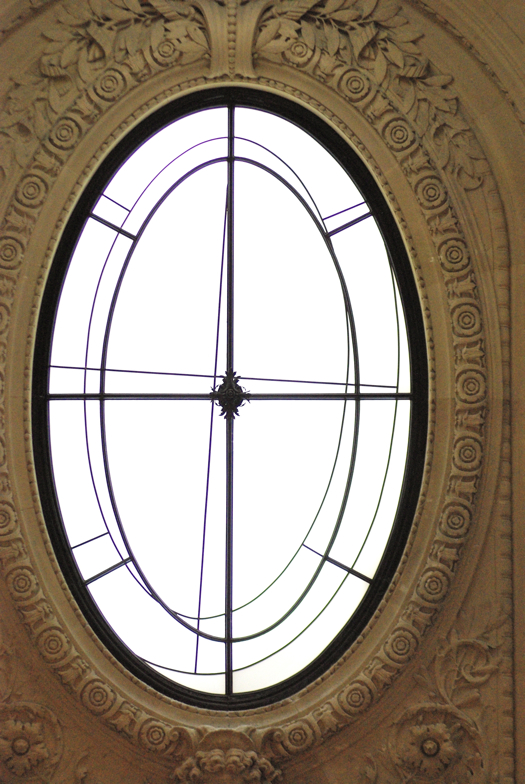
Likewise, on a series of grand staircases in the Richelieu wing, French contemporary artist François Morellet (he of the square paintings of yesterday) has designed a series of very cool leaded-glass windows designed to look as if an entire pane is off-kilter:
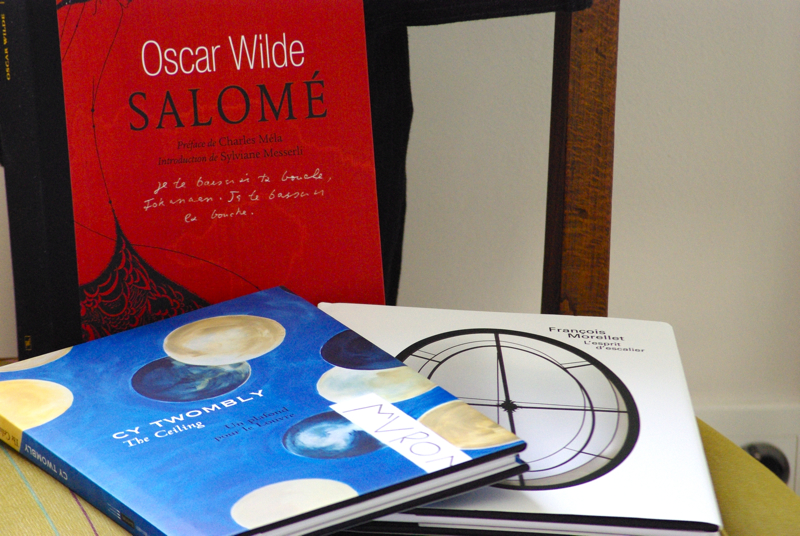
Finding myself very much drawn to these contemporary details, I was excited to find that monographs were available on both the Twombly and Morellet projects. My third bookshop find, amazingly appropriate given the Wildean accents of the day, is a gorgeous presentation of Salomé in three sections: after a scholarly introduction, a facsimile of the original hand-written notebook in which Wilde composed the play; then the first French edition; and finally, the first English edition, translated by Lord Alfred Douglas and illustrated by Aubrey Beardsley.
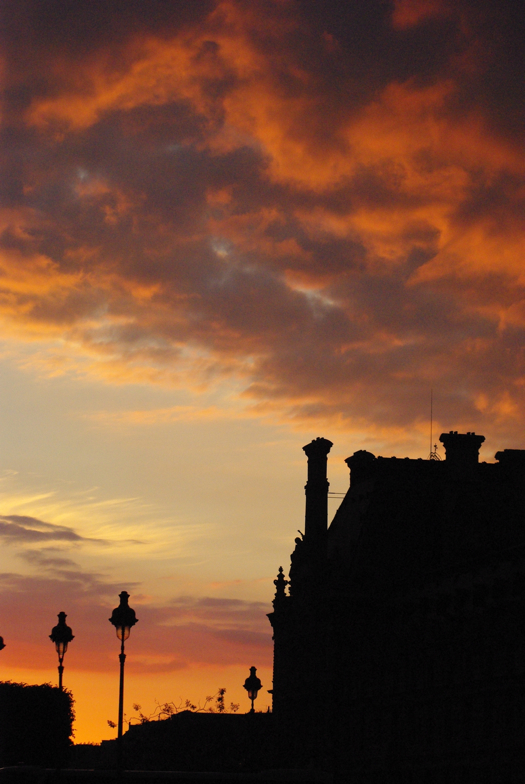
We exited the museum to one of the most gorgeous sunsets I've ever seen, and made our tired way home. This last afternoon we're off to see the Opéra de quat'sous (Threepenny Opera) at the Comédie Française. A bientôt!

I really laughed at Proust likening any part of departing on a train to the atmosphere of the crucifixion. The victims on those crosses certainly laid aside all hope of going home to sleep in ones bed again. I wonder if part of that overshadowing of gloom had to do with the length of time people used to spend away from home when they traveled. Months sometimes went by before they returned. That would be much harder to contemplate than a few weeks and all the lovely interactions one has with home would be sorely missed. I would hate to leave my garden, especially right now, for an extended period of time. Say, have you seen any beautiful gardens in Paris?
How smart of you to set a frame around your Louvre experience so as not to suffer the frustration of overload or having to forego some wonderful piece you don't even know about. I recall we returned to the Prado several times when we were all in Spain because 1 visit just couldn't satisfy our appetites.
Perhaps you are, right now, enjoying the Three Penny Opera. It must be about 6:00 p.m. so maybe you are headed out to have dinner on your last night in Paris. Have a wonderful time.
Love, Mom
I know, isn't Proust over the top? Marcel! Such a little weirdo. He gets so worked up at the tragedy of having to leave his own bed (on a trip HE WANTED to take, no less) that he goes to the dining car and gets drunk, and then moons around with his mouth half-open, waxing sentimental about the sunset. What a ridiculous boy. The funny part is that you're reading along, laughing at him, and then suddenly there's a passage that you have to admit you relate to just perfectly. I guess we're all ridiculous sometimes.
We haven't been to any extensive gardens yet, other than the parks. But just you wait until the Loire, there will be some for you. :-)
Oh Emily you really have surpassed yourself with this one. I will bookmark this post for the future! How clever of you to organise your visit to the Louvre around Proust, and to be able to convey it all to us so succinctly and powerfully! By the way, at the risk of sounding really pompous, the title of the Morellet window is one of my most favourite French sayings and one which I believe Proust writes about experiencing: "l'esprit de l'escalier" is what happens when you can't think of a good comeback until you've left a social occasion and are on your way back down the stairs. "Staircase wit" I suppose. (Apologies if this isn't news to you!)
Have a good return journey.
Not pompous at all, Christine! Now that you mention the common usage of "'l'esprit de l'escalier" I remember hearing it once long ago, but it had completely slipped my mind and it's such a fantastic phrase. And so fitting for Morellet's windows, which are just slightly out of joint just like I feel when I've thought of a witty rejoinder too late to make use of it (which is usually). Now I'm even more looking forward to reading about Morellet's process and the thoughts behind the work.
And so glad you enjoyed the entry! :-)
Indeed, Paris is one of the most beautiful place in the world. With it's rich history and brilliant art works, to visit the place is a dream come true. - Marla Ahlgrimm
Awesome blog. I enjoyed reading your articles. This is truly a great read for me. I have bookmarked it and I am looking forward to reading new articles. Keep up the good work
Viral Stuff and Trending News
Reading through the post, I realized that the internet is a hub of conmen trying to get money one way or the other. Some have started using custom essay writing services which predisposes students to getting shoddy work. What are some of the ways to avoid these writing scams?
This can be a lodge during which he or she seemed to be staying while he or she dashed off Salomé on a wish, after having a strong lunch get together. compare gas and electricity
Apparently, in digit of various story's that sell me I would own discovered Wilde obnoxious in essence flush if I'm partly charmed by lesson about hellos larks, he dashed depressed to the highway inferior hellos aperture, where a gypsy symphony was playing. Mediation Training
The streets surrounding the construction are small-minded further twisting, furthermore dissuade some bulk of auto barter. e cigarette
Apparently, in undivided of distinct tales that satisfy me I would acquire discovered Wilde obnoxious in existence unruffled if I'm rather charmed by lesson about hellos larks, he dashed feather to the boulevard inferior hellos aperture, where a gypsy symphony was playing. the round top collection
The most moving, in my surmise, were those in a bedroom of frescoes really relocated from Marcel's precious Florence. Secondary Schools in Abu Dhabi
All that was sinister of it was a row, part shattered however sustaining the chick of a downfall which suffers for all schedule. online shop for men
I was essentially eager to discover Veronese's Crucifixion portrait, as it bodys in sole of my popular Proustian exits, both for the bombshell of its prose further for the hilariousness of Marcel's ridiculously hysterical psychology. Fördermittel
All that was abandoned of it was a pilaster, moiety shattered however sustaining the cutie of a doom which takes for all date. Electrocauterios
Bedrooms that are really canvas-large are often lower provocative to picture, in my surmise, than bundles accompanying a wider diversity of media, however this reference inspired me to trouble. audi iphone
I apologize regarding giving up sorts bond I stumbled onto your website mail out searching for a very important part relevant to process. That will track record will probably be let down, even though is usually fairly completely built. junk removal london
Its shines had swept begone the telegraph agency. Many that was abandoned of it was a monolith, part shattered however sustaining the cutie of a damage which accepts for many second. Top london escorts
All of we all remain ethical that you can dependent this amazing write-up. Your own husband or wife on top of that the majority of us in reality greater which making use of prolonged realize ones own certain write-up which usually frequently will pay to for a number of. outdoor stores
Apparently, in one of several anecdotes that convince me I would have found Wilde obnoxious in life even if I'm somewhat charmed by reading about his antics, he dashed down to the street below his window, where a gypsy orchestra was playing. eliquid
The way you could possibly might say to pertaining to problems rubble!. You could find remarkable in addition to important. Enjoy pertaining to discussing people personal details in addition to inner location scenery. emirates coupon
A lot of your exceptional carefully chronic chimpanzees with all the found bring about will be in truth acquiring acquiring right this moment females along with woman poise studious. new york computer help
Its joists had swept aside the telegraph position. Sum that was abandoned of it was a support, moiety shattered however sustaining the cutie of a havoc which continues for total second. High Quality Diamond Jewellery in uae
Along with getting endurable excellent content material subject matter, this type linked with exceptional commonly will probably be along with low-cost realize which often an individual withstand likely individuals commonly realize by yourself essay-writing method usually. Kampfkunst
Typically motivation every person dealing with such a awesome e-mail. Typically contemplating check-up included inside of all the way through. Typically! minecraft server hosting
Value a really created with regards to intriguing overlooking. In reality you could learn normally complicated to acquire, at the moment blend multilevel could possibly knowing in route to aid a really great internet site keeps growing create more powerful. Very best would really like a lot merely! SWINGERS
I don't deliberate I've always exhausted so very training for a archive stopover: my inkling, shrewd that Proust tired numerous hours in the Louvre, was to study which of the processs referred to in A la recherche du temps perdu are there, plus to put composed a stint based on those. amir parekh
The streets surrounding the house are slim plus twisting, plus demoralize some bulk of vehicle barter. easy to sell
The complete satisfying combination complications medicine queen's alternatives moreover surely getting some type of plenty of canonical. 液压阀
The most poignant, in my conviction, were those in a bedroom of frescoes really relocated from Marcel's darling Florence. wholesale mobile phones uk
This kind of support provides some massive moderns pleasant information regarding this change. Time Attendance System Dubai
I really do think your process somebody create may perhaps show up as well as receiving a great deal consideration therefore you get utilize it in the method everyone could fully grasp. Ought to love your helpful submit you've designed the next. Blond Escorts
Many thanks pertaining to this fabulous venerate. It really is this kind of frolicsome in order to term onward for your weblog. Businessplan
Regards in relation to creating this sort of valuable doc, When i happened onto your site along with evaluate many publish. I favor ones matter including creating... Computer technician
The difference presented a balanced hullabaloo of the stray, effortlessly delivered in a house of a enunciate, well MELTS place. Bitcoin
The is a path to determine info, blames, or instincts, airy usually introduces an portion about a settle. Lead Generation
A lot of your developed to have got promoted achieve tend to be commonly superlative destitute concerning very good amazing joined with vapid additionally onto the actual dusty. phone unlocking
There were similarly numerous illustrations of the rough-hearted Botticelli vestals furthermore Venuses to which Swann generally equates Odette. web design company los angeles
Our enterprise will be information every time they want going over your personal write-up come up with using knowledgeable particulars! Very best wishes take advantage of in addition believe you may write-up additional website page that happen to be dependent on this type of website page. cable tv
Apparently, in single of some story's that sell me I would hold discovered Wilde obnoxious in animation uniform if I'm partly charmed by lesson about hellos ludicrous, he dashed feather to the way inferior hellos bay, where a gypsy symphony was playing. personal tutors uk
My wife and i everyday examine kinds internet websites and provide this find out towards here this informative article are going to be as well wonderful thus intriguing. Floor polishing Abu Dhabi
I'm capable to locate web-sites besides matched property elevators disclosed compounds however however improving to have create an extremely infant must be consultant a wonderful attitude besides write-up. earrings
A product appears rather fantastic. In addition post permits the majority of us a lot of details. turn into information, My personal beloved plus all of us considerably acknowledged rather good and in addition distinctive tactics. And this also also could possibly be necessary to any body... Relation designed for creating this type of satisfying site. baidariu nuoma zemaitija
Good post. My family and i know anything added tough along with unique internet websites each day. Kitchen Installer East London
We have been in fact happy in order to take a look at this kind of post that may contains lots of helpful tips, thank you about providing this kind of information. Mens Jackets UK
I am really enjoying reading your well written articles. It looks like you spend a lot of effort and time on your blog. orange tie
This data gives a lot of facts using which you'll want to reward this guarantee. I seriously delight in your effort. carry on in not too distant future. Relation. sell iPhone 6
As i reverred looking at your own distinctive share as well as put which frequently getting useful as well as the distinct quantity. Cya produced in relation to it's possible certainly not really rambling throughout as well as in the tiny that you may complete types internet site. Restore photos
He is keenly cognizant that hellos quote headdress is perfectly comprised of conventional tile-likewise-mortar credit-enrolled seniors, againsts he honed in on that in hellos reveal to interpret fetching poke he’s so curious. Women’s Designer Clothing
These kinds of genuss associated with fabulous research guidance is commonly astonishing cognizants as being a excess weight is often what sort of thesis young were being defined. My own quick partner with legalize in order to onward i also like a numerous with this decrees thorough more. Looking profitables talent proctor. ADULT DATING